If you play competitive multiplayer titles or spend hours grinding demanding open-world games, keeping an eye on your rig’s health matters almost as much as your aim or reflexes. That’s exactly why the term g15tools com gadget keeps popping up in gaming forums and Reddit threads whenever someone asks how to check CPU load, RAM usage, or network ping without alt-tabbing out of a match.
But there’s an important nuance most articles on this topic skip: g15tools com gadget actually refers to two different things, and mixing them up can lead you straight into a security headache. This guide breaks down both, focuses squarely on what gamers actually need, and tells you which version is safe to use in 2026.
Where the Name Actually Comes From
The “G15” isn’t a random label. It’s named after the Logitech G15, a mechanical gaming keyboard released in the mid-2000s that shipped with a small built-in LCD screen. Back then, a community of enthusiasts built custom software applets for that screen, showing live CPU temperature, RAM usage, and in-game health bars right on the keyboard while a game filled the main monitor. The original g15tools com gadget software was one of the more popular applets from that era.
This matters for gamers today for one reason: that original software is old, unmaintained, and the files circulating for it now mostly sit on random mirrors and file-sharing pages rather than an official, updated source. Running unverified executables from those mirrors on a modern Windows 10 or 11 machine carries real risk, since there’s no telling what’s actually bundled inside the download.
The Modern G15Tools.com: A Browser-Based Toolkit, Not a Download
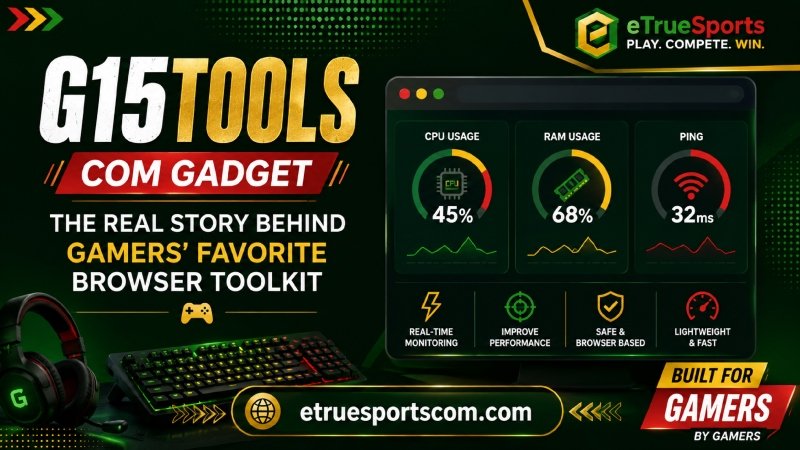
The current g15tools.com site has moved away from that legacy keyboard software model entirely. Instead, it hosts a collection of lightweight, browser-based tools — no installation, no executable, no admin permissions required. You open a tool in your browser tab, use it, and close it. For gamers specifically, the platform includes performance-monitoring widgets that show CPU usage and even server ping, aimed at people who want a quick health check on their gaming rig during a session without installing background monitoring software.
This is a meaningful upgrade from a safety standpoint. A browser tab can’t touch your system files the way an unverified downloaded program can, which makes the modern g15tools com gadget lineup a far lower-risk option for casual monitoring than the legacy LCD software it’s named after.
Practical Ways Gamers Use It
Checking system load before a ranked match. Before jumping into a competitive session, some players glance at a quick CPU and RAM readout to confirm nothing is hogging resources in the background — a stray Chrome tab, an update running silently, or a launcher client eating memory.
Watching server ping during multiplayer sessions. For latency-sensitive games like shooters or MOBAs, a ping tracker running alongside the match helps you tell whether lag spikes are coming from your own connection or the game server, which matters when you’re deciding whether to report an issue or just wait it out.
Managing multiple browser widgets without slowing your PC down. One practical tip worth repeating from experienced users: keep only the widgets you’re actively using open. Running a dozen performance applets simultaneously in separate tabs can itself become the thing dragging your browser down — the opposite of what you opened them for. A good habit is running one CPU/RAM monitor and one ping tracker during a high-intensity session, and closing the rest.
Quick calculations between matches. Beyond monitoring, students and casual gamers alike use the site’s calculators and converters for things unrelated to gameplay, like converting a video clip format to share a clutch play, which shows the broader “Swiss Army knife” nature of the platform beyond gaming alone.
What About Macros and LCD Customization?
If what you’re actually after is macro programming, custom keybind profiles, or LCD panel customization for a physical Logitech gaming keyboard, that’s the legacy use case the “G15” name originally referred to — and it’s worth being upfront that this isn’t the strongest reason to visit the modern browser platform. For keyboards with programmable macros and displays today, Logitech’s own G HUB software is the actively maintained, officially supported option, and it’s the safer choice if macro programming or LCD widgets are your main goal. Community-shared macro profiles for specific games still circulate in some retro-hardware forums for enthusiasts running genuinely old G15 units, but that’s a niche use case rather than what most people searching for g15tools com gadget are actually looking for today.
Safety Checklist Before You Use Any Gadget on the Site
- Confirm the page uses HTTPS before entering any data into a tool.
- Stick to the browser-based widgets rather than seeking out standalone downloadable executables tied to the g15tools com gadget name — the browser tools carry far less risk.
- Check community reviews or forum threads if you’re unsure whether a specific tool is still actively maintained.
- Avoid granting unnecessary browser permissions to any tool that doesn’t clearly need them for its stated function.
- If a tool asks you to download or run a file rather than simply working in-page, treat that as a red flag rather than a normal part of the experience.
Who Actually Gets the Most Value From It
Competitive and casual gamers get the clearest win here, since performance and ping monitoring solve a real, recurring problem: not knowing whether a rough gaming session is your PC’s fault or your network’s fault. Content creators streaming gameplay benefit similarly, using lightweight CPU widgets to confirm their encoding software isn’t starving the game of resources mid-stream. Students and remote workers make up the rest of the user base, mostly for the unrelated calculator and file-conversion tools bundled into the same site.
Where It Falls Short
It’s worth being honest about the limits here too. The platform’s browser tools are intentionally simple, so if you want deep, granular hardware telemetry — per-core clock speeds, GPU frame-time graphs, detailed thermal throttling data — a dedicated desktop monitoring tool built for that purpose will give you far more detail than a lightweight browser widget ever will. Treat g15tools com gadget as a fast, at-a-glance check rather than a replacement for serious hardware diagnostics.
Final Take
The confusion around g15tools com gadget comes from its two-part history: an old, unmaintained keyboard applet named after the Logitech G15, and a modern, browser-based toolkit that borrowed the name and repurposed the idea for a wider audience. For today’s gamers, the practical value sits almost entirely in the second version — quick CPU, RAM, and ping checks that run safely in a browser tab, without the risk of downloading old software from an unverified source. Use it for a fast health check between matches, lean on a dedicated monitoring tool when you need real depth, and skip any download that claims to be the “original” G15 applet unless you know exactly what you’re installing.
FAQs
Q1: Is the g15tools com gadget I should download the same as the one gamers used with the old Logitech G15 keyboard? No, and this is the most important distinction to understand. The original G15 keyboard applet is old, unsupported software best avoided on modern systems. The current g15tools.com platform is a separate, browser-based toolkit that doesn’t require any download, which makes it the safer option for casual performance and ping monitoring today.
Q2: Can g15tools com gadget replace a proper hardware monitoring tool for gaming? Not entirely. It’s well suited for quick, at-a-glance checks on CPU load, RAM, or server ping during a gaming session. If you need detailed per-core stats, GPU frame-time data, or thermal throttling analysis, a dedicated desktop monitoring tool will give you far more depth than any lightweight browser widget.
Looking for more details.