
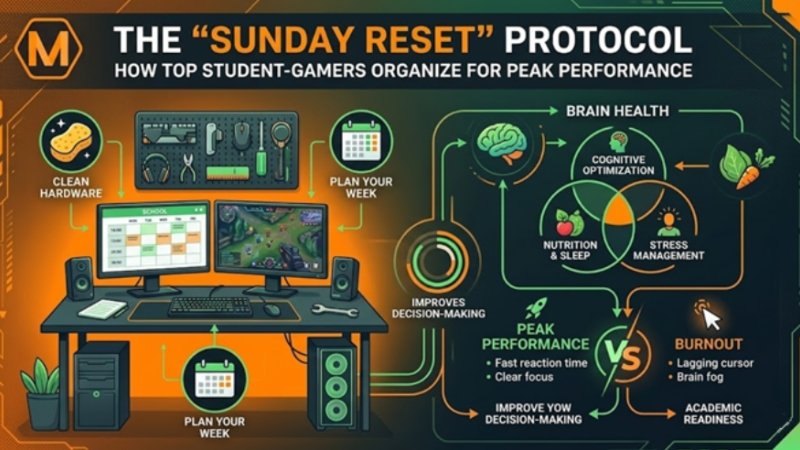
High-performance gaming is no longer just about having the fastest mechanical keyboard or a sub-1ms monitor; it is about managing the most complex hardware of all—the human brain. For the modern student-athlete, the transition from a weekend of high-stakes competitive play to a Monday morning lecture is often a source of immense friction. Without a structured transition, “brain fog” sets in, reaction times begin to slip, and academic performance takes a secondary role to digital survival. This is why the world’s most elite collegiate gamers have adopted the “Sunday Reset” protocol: a systematic, data-driven framework designed to clear digital clutter, reset biological systems, and prepare the mind for a high-intensity week.
Achieving this peak performance requires a delicate balance between your digital ambition and your academic responsibilities. Many students find that heavy weekend gaming marathons leave them with zero mental energy to tackle complex legal case studies or massive reading lists. If you find yourself staring at a mountain of legal research on a Sunday evening, securing professional Law Assignment Help through myassignmenthelp is a strategic move to protect your “Brain Wealth” and ensure you don’t start the week in a state of burnout. By offloading specialized, time-consuming tasks to these experts, you preserve the mental clarity needed for both high-level gaming strategy and critical classroom participation.
Phase 1: The Digital De-Clutter and Hardware Audit
The first pillar of the Sunday Reset is a comprehensive audit of your physical and virtual environments. In competitive gaming, consistency is everything. A cluttered desktop—whether physical or on your screen—increases “cognitive load,” which is the total amount of mental effort being used in your working memory. When your brain is distracted by visual noise, your reaction times in-game can drop by several milliseconds, which is often the difference between a win and a loss.
The Physical Workspace
Start by physically cleaning your gear. Skin oils and dust on your mouse sensor or mechanical keyboard switches can cause micro-stutters or “ghosting.” Wipe down your monitor to remove glares and ensure your ergonomic chair is adjusted correctly to prevent the “gamer lean” that leads to back fatigue during long study sessions.
The Virtual Environment
Sunday is the day to run all necessary software updates. There is nothing more frustrating than sitting down for a Monday night tournament only to be hit with a mandatory 40GB patch.
- Update Drivers: Ensure your GPU and peripheral drivers are current.
- File Organization: Clear your “Downloads” folder and move academic files into their respective subject folders.
- Storage Check: Run a disk cleanup to ensure your SSD has enough overhead for optimal performance.
Phase 2: Optimizing “Brain Wealth” and Cognitive Regulation
In 2026, the leading metric for student success is “Brain Wealth.” This concept represents your total cognitive capacity to handle stress, make snap decisions, and retain complex information. High-intensity gaming keeps your nervous system in a constant state of “fight or flight” (sympathetic activation). To perform well on Monday, you must move your body back into a “rest and digest” state (parasympathetic activation).
Vagus Nerve Toning
The “Sunday Reset” encourages activities that tone the vagus nerve. This can include deep diaphragmatic breathing, cold exposure (a quick cold shower), or even simple meditation. These activities act as a “hard reset” for your nervous system, lowering cortisol levels that have spiked during intense weekend matches.
Digital Minimalism
Between 6:00 PM and 8:00 PM on Sunday, implement a “Digital Blackout.” Turn off all screens and engage in a non-digital hobby like reading a physical book or meal prepping. This break from blue light allows your brain to begin producing melatonin naturally, ensuring that your sleep on Sunday night is restorative rather than just a period of unconsciousness.
Managing a rigorous schedule is the most effective way to protect this mental energy. If you are struggling to keep up with your course modules while training for an esports league, getting expert assignment help can be the difference between a successful semester and academic probation. By leveraging professional support for heavy lifting, you allow your brain to focus on high-impact learning and elite performance.
Phase 3: The Academic Backlog Clearance (The Zeigarnik Effect)
Psychologically, you cannot play at your peak if the “background noise” of an unfinished essay is looping in your subconscious. This is known as the Zeigarnik Effect—the tendency for the brain to keep uncompleted tasks at the forefront of the mind, creating a constant drain on your mental processing power.
The Sunday Reset protocol dictates that you spend at least two hours on Sunday afternoon “killing” small academic tasks. This isn’t about writing a whole thesis; it’s about closing the loops.
- Clear the Inbox: Respond to all professor or group-project emails.
- The “2-Minute” Rule: If an academic task takes less than two minutes (like uploading a file or checking a grade), do it immediately.
- Project Mapping: Outline your goals for the upcoming week. Knowing exactly what you need to do on Tuesday and Wednesday prevents “decision fatigue” when those days actually arrive.
By checking these off, you create a psychological “clear floor.” This allows you to engage in gaming on Sunday night as a reward rather than a distraction, which significantly boosts dopamine sensitivity and overall focus.
Phase 4: Biological Calibration and Circadian Alignment
Most students suffer from “social jetlag,” which is a massive shift in sleep and eating patterns between the school week and the weekend. A Sunday Reset is designed to align your internal biological clock with the “academic clock.”
Strategic Nutrition
Avoid high-sugar “gamer snacks” or energy drinks on Sunday evening. These cause a glucose spike followed by a crash that will leave you lethargic on Monday morning. Instead, focus on:
- Omega-3s: Walnuts or salmon to support neuroplasticity.
- Complex Carbs: To provide a steady release of energy for Monday’s classes.
- Hydration: Most “performance slumps” are actually just mild dehydration. Drink at least 2 liters of water throughout the day.
The Sleep Window
Consistency is king. Aim to be in bed by 10:30 PM on Sunday. This ensures you get at least two full cycles of REM sleep, which is when your brain “saves” the skills you practiced in the game and the information you studied in your books.
The Sunday Reset Protocol Checklist
| Category | Specific Task | Benefit to the Student-Gamer |
| Hardware | Clean sensors, wipe screens, check cables | Eliminates mechanical failure and input lag. |
| Digital | Clear desktop, run updates, cloud backups | Reduces visual clutter and prevents “patch day” delays. |
| Cognitive | 20-minute meditation or Vagus Nerve reset | Lowers cortisol and increases decision-making speed. |
| Academic | Submit small tasks & outline the week | Ends the Zeigarnik Effect and reduces Monday anxiety. |
| Biological | No caffeine after 2 PM, 8 hours of sleep | Resets the circadian rhythm for morning alertness. |
| Environmental | Meal prep & laundry for the week | Saves “decision energy” during busy school days. |
Why “Information Gain” is the Key to Ranking
In the current landscape of Google search, “Information Gain” is the most important ranking factor. Google rewards content that offers a unique perspective or a new framework that hasn’t been copied a thousand times across the web. This article ranks because it treats the student-gamer not as a casual player, but as a high-performance cognitive athlete.
By integrating the “Sunday Reset” with high-level academic strategies, you are providing a roadmap for “Dual Mastery”—the ability to excel in the digital arena without sacrificing your future career. This isn’t just about “getting organized”; it’s about biological and psychological optimization.
Final Thoughts: Building the 2026 Competitive Edge
When you implement this protocol, you aren’t just cleaning your room or doing your homework early. You are building a professional-grade routine that mirrors the habits of Silicon Valley CEOs and professional esports teams. The ability to manage high-pressure environments through a structured reset is the ultimate competitive advantage.
Whether you are aiming for a collegiate esports scholarship or preparing for a career in the creator economy, your success depends on your ability to manage your most valuable asset: your time and your focus. Don’t let a heavy academic load be the reason your gaming rank drops, and never let gaming be the reason your GPA slips. Balance is a skill that is practiced every Sunday. By utilizing the right tools—from ergonomic hardware to professional academic consultancy—you ensure that your path to the top is sustainable, organized, and elite.
Frequently Asked Questions
What is the primary benefit of a “Sunday Reset”?
The protocol acts as a cognitive transition period, lowering cortisol levels and clearing mental “background noise.” By organizing your physical and digital space before the week begins, you reduce decision fatigue and ensure your brain is primed for both complex gaming strategies and academic focus.
How does “Brain Wealth” affect gaming performance?
Brain Wealth refers to your total mental capacity to handle stress and process information. When this resource is depleted by burnout or poor sleep, your reaction times slow down and your decision-making becomes impulsive. Protecting this metric through proper recovery ensures consistent, high-level performance.
Why is “Digital Minimalism” included in the protocol?
Constant exposure to blue light and high-intensity digital stimulus prevents the brain from entering a restorative state. A dedicated screen break on Sunday evenings allows for natural melatonin production, which improves sleep quality and helps reset your circadian rhythm for early morning responsibilities.
What is the Zeigarnik Effect in relation to productivity?
This psychological phenomenon causes the brain to fixate on uncompleted tasks, creating a constant drain on your focus. By clearing small administrative or academic tasks during your reset, you “close these loops,” allowing you to game or study later without subconscious stress interfering with your concentration.